
Why I don’t rely on “TSS”

Posted in Racing Tips, Training Tips on April 7, 2013 by Gleason Endurance Coaching

OK, I know that this is written really more for the benefit of coaches than athletes. Still, I know that some of you coaches out there may be reading this, and many others are self-coached, so, well, here we go (this one is a bit lengthy):

First, what are we talking about? Before you go running around with your TSS status, thinking you’ve got the holy grail of training and performance in your pocket, read on.

What the heck is “TSS” – (Training Stress Score) is a numerical value assigned to any single workout or race. It’s intended to directly measure the “training stress” - or the physiological cost of that specific event.  It is based on an algorithm using your threshold levels, measured via a common metric such as power (Watts) or pace, the duration of the session, and a little math.  It accumulates from day-to-day,  week-to-week, even month-to-month, depending directly upon how often, how long and how hard (intensely) you work.  To measure it over time, we (i.e. a software program) run 7-day, and 42-(or more)-day moving averages. These are called “acute training load” (ATL), and “chronic training load” (CTL), respectively.  By tracking these together over time, a coach or athlete can theoretically measure fitness, fatigue and “form”  (race readiness).  You get a chart that looks like the one below, called a “Performance Management Chart” (PMC).  Pretty valuable right? Well, maybe .. (click on for larger image)

PMC chart

Performance Management Chart
Blue line = fitness (CTL), Pink line = fatigue (ATL), Yellow line = “Form” (race readiness)

  • The primary reason I do not rely much on TSS is that it only attempts to measure “training stress.” It does not measure life stress. You know, the stuff going on in your life the other 20 or so hours a day when you’re NOT training.  What about that?  It’s up to you to measure.
  • It is a loose approximation at best of actual physiological stress on the body.
  • Everyone responds differently to different training stresses.  For example, an 11 mile, 90 min run for 2 different athletes with the same running profile (threshold pace) will produce similar TSS scores.  However, it takes no account of individual strengths and weaknesses.  If one runner is highly aerobically oriented and fit, durable, and experienced, while the other is anaerobically oriented, maybe better on hills, better at speedwork, (perhaps a sprinter by training), the effect on these 2 athletes is very different, even though their TSS scores will be very close. (Yes, these 2 runners can have the same Threshold Pace.)
  • It ignores harder to measure factors, such as re: swimming; What about open water conditions? Swimming a mile in a pool vs. open water can be easy vs. brutal (at the exact same pace). It also relies too heavily on HR in the absence of a power data (bike), and pacing info for an entire run, or swim. (The “TRIMP score”).
  • It assumes that your FTP, T-Pace (swimming), and Threshold running Pace are in fact accurate.  Yet, they are always moving targets, and vary up and down (rather quickly) according to how fit and fatigued an athlete is at any point in training.  So, a ride with a TSS of 150 on one day is very, very different in terms of physiological cost (what it purports to measure directly) compared to another day, or from one side of a whole training block to the other.  That is, TSS does not factor in an additional measure of  accumulated stress (ATL or CTL, the metrics tracked) for any individual workout.  In other words, a workout with a TSS of 150 is counted the same, whether or not you do it fresh and rested at the start of a training block, or pretty much fried at the end of the block.  (Why I argue that TSS moves much more on a daily basis than we account for.) This is the job of the athlete and the coach working together.
  • Again (and so important); TSS totally ignores the rest of your life:  rest, sleep quantity and quality, nutrition (a HUGE FACTOR), hormonal (im)balance, relationship, family, and job issues, underlying health issues (not directly related to fitness).  It misses big, and critical – arguably the most critical – variables.
  • It is backwards looking by design, and therefore, not necessarily a good predictor of how ready an athlete is to train hard, (or even what to do) on any given day.  That comes down to projection, a game which is, well, a guessing game (even for the best statistician).
  • And one of my favorites; That which is measured is NOT necessarily improved.  Just because we can measure something, does not mean we can change it for the better, or at all.  I can measure how tall I am.  I can measure how many fingers and toes I have.  I can measure other more mutable characteristics like fasting blood sugar, LDL count,  HbA1C count, blood pressure, and body fat %, and my HR at my 10K race pace, but I may have no idea whether or not the numbers I get are good, bad, indifferent, or irrelevant to my goal.

I’ve had athletes perform exceptionally well when their PMC chart predicted they were fatigued and not ready for a good performance.   On the flip side, I’ve had athletes whose numbers were optimal on the chart have flat and mediocre days, only to excel at a different, less optimal point on the same chart.

What’s the take away?  Trust your own instincts working with your coach, and learn to intuitively feel your own fitness, fatigue and race readiness without the use of a rigid and narrowly focused PMC chart.

Don’t get me wrong, TSS is useful.  Just probably not as useful as it appears. I still use it to help guide my coaching, but just not in isolation.  When used in its proper context, it can be pretty useful.  However, that context is becoming smaller and smaller, the more I discover what it is that TSS actually does measure.

VO2 Myth

Posted in Skills, Training Tips on April 4, 2013 by Gleason Endurance Coaching

“VO2 max” is an often discussed topic, particularly in terms of training, and an athlete’s capacity for performance.  It is a very important attribute. However, it seems to me it’s widely misunderstood when comes to establishing training objectives.  You’ve probably heard an athlete somewhere say something like, “I’m going to do VO2 max intervals tomorrow.” Or even, “I want to improve my VO2 max…” There is even a “VO2 max Zone” in many coaches’ Zone Training protocol.  The typical misconception is that it is a highly trainable physiological trait.

In fact, it generally is not. It is the most immutable of the three physiological attributes endurance athletes are concerned about. Can it be improved, especially from an untrained, or de-trained starting point? Yes, of course, and certainly it should be.  However, there is a low ceiling on improving this particular trait, and that’s mostly set by your parents (Yes, genetics largely determines “VO2 max”.)  So, of course you should be really careful when deciding on parents.  Regardless, trying really hard to alter your largely genetically predetermined “VO2 max” is sort of like trying to get taller. runner VO2 max pic

Attributes that are highly trainable, and should probably get the lion’s share of attention in training are (“lactate”) Threshold Levels (even though lactate – i.e. lactic acid – is only a very indirect measure of this phenomenon), and Economy (aka, efficiency or skills).  [Lactate, or "lactic acid," is associated with acute muscle acidosis, which is believed to be accounted for by an accumulation of hydrogen ions, a by-product of metabolic activity, which increase very rapidly at increasingly higher workout intensities.]

Another misconception of VO2 max is that it’s all about your cardio-respiratory system.  It’s really more about muscles, i.e. capillary size and density in your muscles. (Capillaries are the site of O2/CO2 exchange in the working muscles.)  The more O2 your capillaries can delivery for use to working muscles, the more work (metabolic energy production) your muscles are able to perform.  Your lungs and heart are usually pretty good at delivering oxygenated blood there, and returning CO2 enriched blood (and hydrogen ions), to the heart and lungs to be re-oxygenated and/or breathed off.

“VO2 max,” in theory, measures the amount of oxygen that your body can utilize to perform physical work.  That’s it.  It has nothing directly to do with how fast you run, or how much weight you can lift, or how good are from the 3-point line.  It’s units are: Volume of O2 (liters) per Kg of body weigh per minute (L O2/Kg x Min).

So, what’s the take away?   Don’t spend a lot of time training for “VO2 max” effort, as a goal in itself. Rather, spend the time training for efficiencies at your specific level of intensity, needed for your next race.  That may include “VO2 max” efforts (e.g. 3 min run intervals at faster than 5K race pace effort), or it may not.  It may mean going for 5 hours on your bike at a moderate aerobic effort (IM athletes) which is nowhere near “VO2 max.”  If you train at high intensity and/or very high volume, your “VO2 max” will take care of itself.

CA 70.3, 2013

Posted in My Athletes, Race Reports on April 3, 2013 by Gleason Endurance Coaching

I was on the sidelines this year for the Race (where I belonged), so I got an upfront view of an outstanding day!

Quick results for my athletes:

Riikka -aka Noko - Aramo:  True to form, Noko took 2nd in her AG at CA 70.3, and went under 5 hours for the first time in her 70.3 career! (4:59!)  After a blazing swim of 26:57 and very strong bike split of 2:44, she held off some runners to maintain her lead for the 2nd place finish!  Congratulations Noko, you trained hard, smart and you were on your game!  You deserve it.

She continues to out race the field. After racing a “tune-up” sprint at the Super Seal in Coronado, where she WON the women’s field overall, and dominated from start to finish on the Sprint Course, we were feeling good about Oceanside.  Next: Oly distance racing.  If you’re a 40-44 female, short course racer, you just got bumped down a rung.

Ryan Spitz – He had a breakthrough day.  Crushing his time of 5:15 from last year by 13 min to go 5:02 this year at CA 70.3, good for 19th, Ryan continues to grind and mash his way up the ranks of one of the most talented and competitive AG’s – 25-29.  Ryan has made huge progress on all disciplines, not least of which, the swim.  Ryan crushed his swim time from last year, going 30:29 this time.  That’s about a 7 min improvement on a 1.2 mile course!  That is no fluke. That is a breakthrough.  Congratulations Ryan!  The rest of the season looks solid.

Beyond Training

Posted in Food and Health on March 7, 2013 by Gleason Endurance Coaching

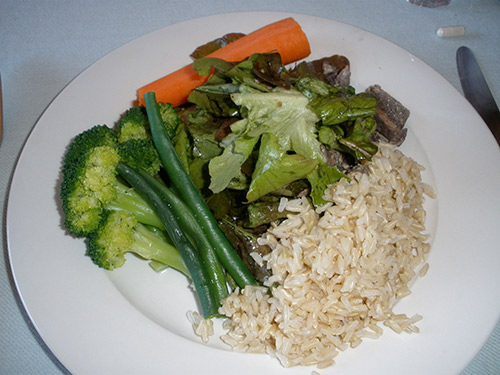
I once had a newer triathlete ask me some advice on diet, nutrition and how to support their training.  My response at the time was “Don’t eat crap food.” It was a tongue-in-cheek sort of half joke, really not meant as serious advice.  ..Yet still was kinda serious.  I meant, really, if you’re eating “crap food,” which at the time I meant to include most highly processed, low-nutrient, high calorie-ratio food, you ought to stop.  I also was sort of trying to dodge a real answer, because in part, I was not really ready to answer the question, at least off the top of my head.  I had only been coaching for a couple of seasons then.  I since have learned a lot from experts like Bob Seabohar, and many others in endurance sports. More importantly, I hadn’t yet done a lot of extensive research and general investigation of all sorts of different resources, outside of endurance sports.

OLYMPUS DIGITAL CAMERA

Now, I have. Or at least I’ve begun.  As an attorney, I learned how to research a topic and dig-in on it.  Now I’m putting that to use here. What I’m learning the more I dig is pretty ugly and disturbing -  on many levels.

I’ve come a long way from “don’t eat crap food.” Now, I can elaborate.  I have come to greatly appreciate the role nutrition plays in the daily life, and the quality of life of every human being, which I’m pretty sure still includes most serious endurance athletes (especially ones trying to gain a fair advantage the safe, legal, and non-cheating way.)

I plan to share a lot of revelations, and experiences – some personal, hard  lessons learned - a lot of stories of people very close to me, those of other athletes, friends, etc. on the topic of food.  I’ll do it here on my coaching blog, because although they are not the same typical training issues, they are closely related. There is much overlap with coaching, training, racing and performance.  Honestly, it’s very exciting to me,  and I cannot wait to learn, share, and hopefully move the nutritional ball down the field, for better public (and athlete) health.

Please stay tuned.

..and please tell me if you’re interested, or can teach us something..

So you can’t win a triathlon in the water, huh?

Posted in Racing Tips, Skills, Training Tips on April 21, 2011 by Gleason Endurance Coaching

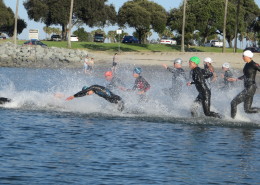
swim trainingIf you think this “conventional wisdom” is true for any triathlon, except perhaps an IM, please look at the results of Ironman California 70.3 from Sat, April 2, 2011, and March 31st, 2012 (and probably March 30th, 2013 in one week).  Check out Andy Potts very impressive wins.  It can be argued that the difference was his gigantically dominant swim performance – where he was more than 1 whole minute out in front of pro-competitor #2 into T1 (both years)!  Then, look at the margin of error at the finish. Yeah…   You can win (or podium) a triathlon in the swim.  Forget “conventional wisdom.”

Is it time to reconsider the swim as merely defensive?  I say it is.  And if you think you can’t improve your swim, or it doesn’t really matter for racing triathlon, please send me an email.  I believe you need to talk to me  :)

And this was on a 70.3 course!  If it’s true there, it is for sure true in short course racing, i.e, Oly’s and sprints, even non-drafting events where the gap a strong swimmer can put on the field is even harder to bridge.

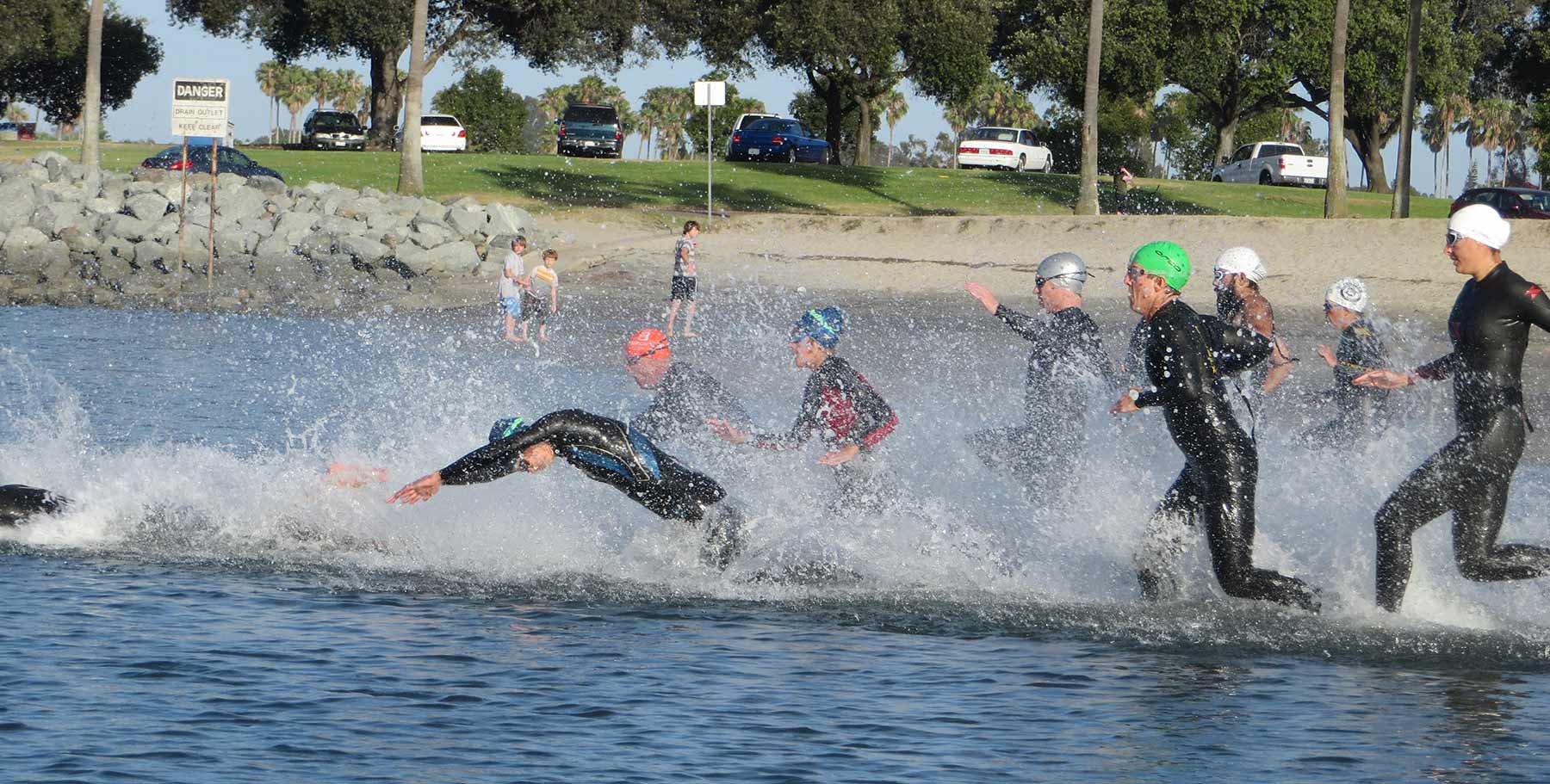
open water start

Time to get in the water.

Consistency and Interruptions

Posted in Consistency, Training Tips on June 7, 2013 by Gleason Endurance Coaching

I say it all the time, like almost all good coaches, and endurance sports athletes who’ve been at their sport for more than a season or two.  That’s because its true:  staying consistent in training for endurance sports is your best ally.  The flip side to maintaining that valuable consistency is moderation in nearly every aspect of your training.

So what about when you’re forced to miss a chunk of training? First, don’t fret.  I’ve recently had athletes miss small to larger blocks of training for various reasons: injury, vacation, work & life obligations, equipment issues, etc. The reason really is not the most important thing.  Even if its injury, you can manage it.  You can fix gear, you can cross-train at other activities when you’re forced to stop one sport.  For example, if you can’t run or swim, you can do something entirely different.  If you can’t run, then you can walk, hike or even get on the elliptical (though I’m not a fan as a substitute for running).  If you can’t swim, then you can strength train, spin, or do yoga, or all of those. The point is to maintain some basic level of aerobic activity and strength as best you can at the time.

The most important thing to keep in mind through a down period is that you probably won’t lose as much fitness as you think you will, and that you get back at it!  It’ll be there for you when you’re ready.

Born to Run..

Posted in Consistency with tags , on October 6, 2012 by Gleason Endurance Coaching

” …’We live in a culture that sees extreme exercise as crazy,’  Dr. Bramble says, ‘because that’s what our brain tells us: why fire up the machine if you don’t have to?’ … “Nearly every top killer in the Western World – heart disease, stroke, diabetes, depression, hypertension, and a dozen forms of cancer – was unknown to our ancestors. They didn’t have medicine, but they did have a magic bullet… You could literally halt epidemics in their tracks with this one remedy… (Dr. Bramble said) … The Running Man. ‘So simple’ he said, ‘Just move your legs.  Because if you don’t think you were born to run, you’re not only denying history, you’re denying who you are.”  - Christopher McDougall, Born to Run, Random House, 2009, Chp. 28

A smart friend of mine, who is also a sport medicine physician, once told me, “exercise is medicine.”

I could not have said it better…

If you’re reading this, you may believe, like I do,  that its crazy not to run, or even do “extreme exercise.”  Let’s reevaluate, and perhaps redefine, “crazy.”

Harmony

Posted in Uncategorized on June 22, 2012 by Gleason Endurance Coaching

Are your mind and body hitting the same notes at the same time? Are they in agreement? Are you in harmony with yourself in your athletic life?  Often times, we are out of sync with ourselves internally when it comes to motivation to train, enthusiasm, and physical fatigue.  This can have a very negative effect on training, as you may be ready to go hard when your body is trying to tell you “NO! you need rest.”  At other times, you might be well rested, well nourished, with high energy levels, and primed to advance your fitness. Yet, you might be completely unmotivated, down,  mentally burned out, stressed by life’s other real problems, or just plain old feeling lazy.

Getting the most out of your hard workouts requires that you are more than merely physically ready to train hard.   It also requires that you are actually eager to push forward, eager to suffer somewhat (as crazy as that may be..) but not too much, and at least adequately motivated to train.  This requires harmony between mind and body.

In order to get the most out of each high quality training session, of which you may have as many as 4 or 5 per week, you need to be ready on both levels.  Just going through the motions won’t get you to where you need to be.  So, where do you need to be?  You need to be able to dig just a little, push yourself a little harder than is comfortable and know when to pull back.  This is highly individualized,  There is no clean metric for this, no hard and fast rule.   Power, HR, pace, yards, accumulated training stress (I use TSS to measure this) can get you much closer.  These metrics do narrow down the process.  But the last 1% to 5% of training is the most critical part.  This where the science of training blends (somewhat mysteriously) into the art of training.  To become the artist you should become to maximize you training, work closely with your coach, use all the metrics available to you, and get to know what you can, and more importantly cannot handle.  The best way to do this is still trial and error.

As serious athletes, we’re all chasing those last few percentage points of gain.  That is where podium spots are earned, elite licenses gotten, championship qualifications achieved, and truly inspired and amazing goals accomplished.  To reach this level, I would suggest that as an athlete, you must be in harmony.

-Coach Bill

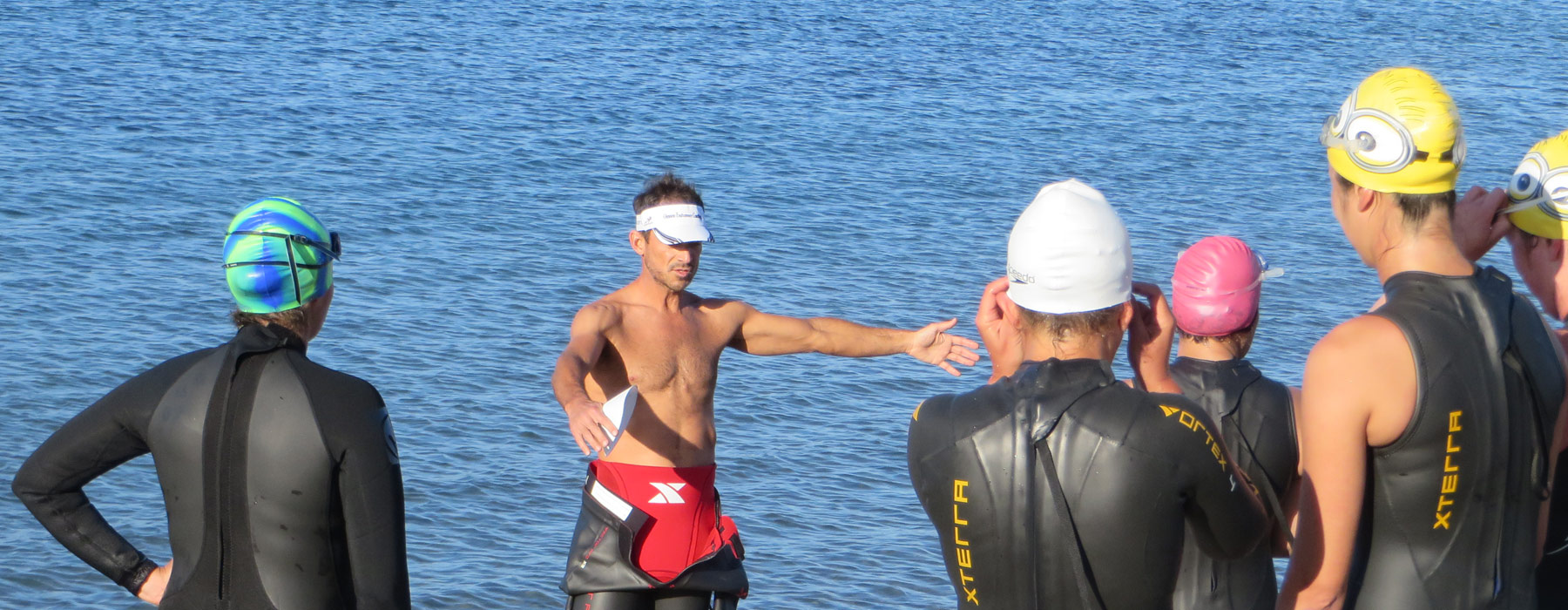
Gettin’ after it! Gleason Endurance Coaching Thurs PM, Open Water Workout


Follow

Get every new post delivered to your Inbox.

Join 35 other followers